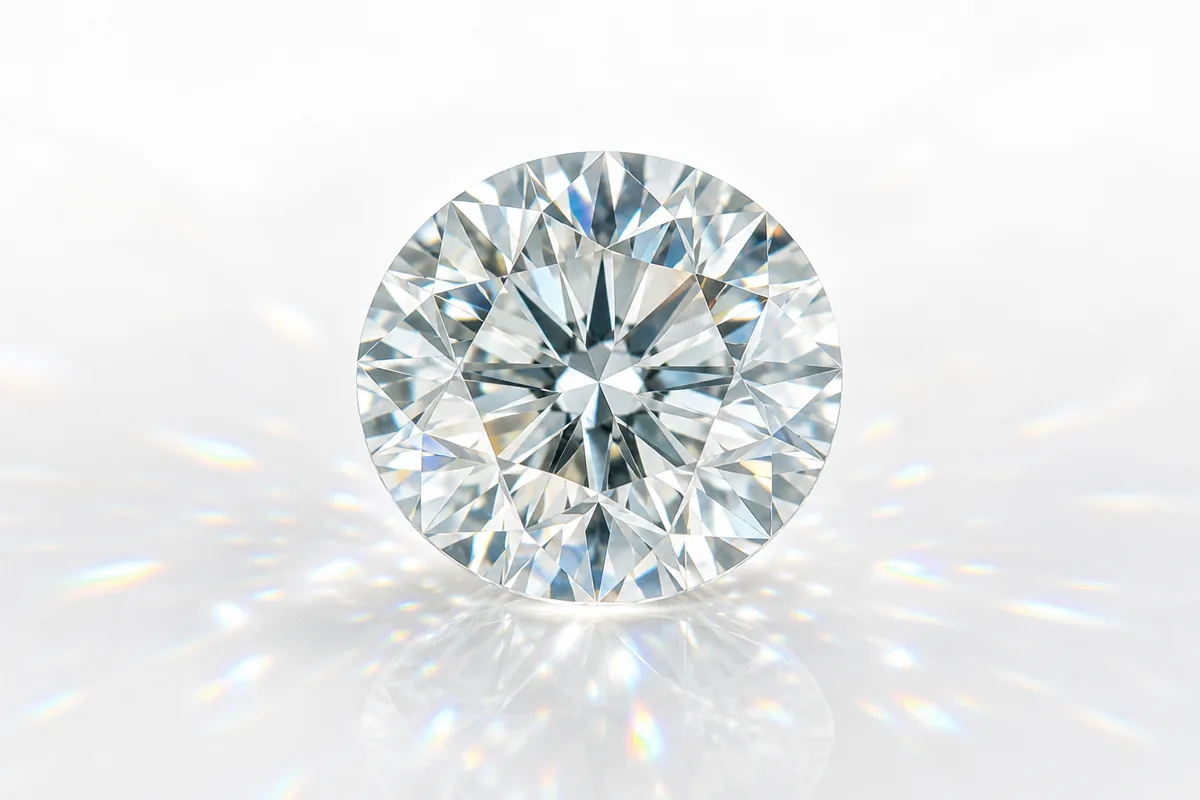
Why carat and size are not the same thing
A diamond's face-up diameter is determined by how the cutter distributes the weight. A stone that carries its weight in depth, meaning a steep pavilion and deep crown, can look notably smaller face-up than a stone of the same carat with better proportions. Millimetre diameter is the honest measure of how large a round brilliant will look in a setting. A 1ct round brilliant with good cut proportions typically measures around 6.4 to 6.5mm in diameter. A poorly cut 1ct stone can measure 6.0mm or less. That difference is visible.
Magic weight thresholds and price jumps
Diamond pricing does not increase in a straight line. Prices step up at popular weight thresholds because buyer demand concentrates there. The main steps are at 0.50ct, 0.75ct, 1.00ct, 1.50ct, and 2.00ct. A 0.95ct diamond from the same manufacturer with the same colour, clarity, and proportions as a 1.00ct stone may price meaningfully lower while looking virtually identical face-up. Buying just below these thresholds is a legitimate way to extend value without visible compromise.
How carat interacts with cut, colour, and clarity
A large, poorly cut stone looks duller than a smaller, well-cut stone. A 1ct stone with a poor cut grade loses light and appears flat. A 0.85ct stone with a GIA Excellent cut grade can outperform it visually. Similarly, colour and clarity grades that serve well at 0.50ct may be inadequate at 1.50ct, where the stone's face-up area amplifies both warmth and inclusions. When buying at higher carats, the four Cs interact more strongly, and each grade carries more weight.
Accessing certified natural diamonds at specific carats through Prodiam
4Cs.co.za, a De Beers DBCM Emerging Beneficiation Customer since 2019, manufactures certified natural diamonds through a South African cutting works and a South African cutting works in Bedfordview, Johannesburg. With direct rough access and 25 years in the SA diamond trade, Prodiam can source certified stones at specific carat targets, proportion requirements, and budget levels, typically at 30 to 40 percent below national retail. For SA buyers seeking a specific carat, remote consult with full certificate data is available. Contact: Prodiam. By appointment. Natural 1ct diamond rings in SA retail from approximately R30,000 to R200,000 depending on the four Cs and buying route.
Decision table
Use the details, not a shortcut.
| Carat range | Typical face-up diameter (round) | Price jump notes | What to prioritise |
|---|---|---|---|
| 0.40-0.49ct | 4.7-5.0mm | Below 0.50ct threshold, lower price step | Cut and spread for visual size |
| 0.50-0.74ct | 5.0-5.8mm | At or just above 0.50ct step | Certificate, eye-clean clarity |
| 0.90-0.99ct | 6.1-6.3mm | Just below 1ct premium | Proportions and colour for face-up quality |
| 1.00-1.49ct | 6.4-7.3mm | 1ct premium applies | All four Cs interact more strongly |
| 1.50-1.99ct | 7.3-8.0mm | 1.50ct step, strong jump | Lab, make, fluorescence, resale demand |
| 2.00ct+ | 8.0mm+ | 2ct premium, significant | Colour and clarity amplified, GIA essential |
Direct answers
Common questions
Is a 1 carat diamond always larger than a 0.90 carat diamond?
Not necessarily face-up. A well-cut 0.90ct stone with good proportions can measure the same or larger in diameter than a poorly cut 1.00ct stone that carries weight in depth. Always compare millimetre measurements.
What does it mean when a diamond carries weight in depth?
It means the cutter preserved more of the rough diamond's mass in the lower portion of the stone rather than maximising the face-up diameter. The stone weighs more per millimetre of face-up area than a well-spread stone.
Why is a 1ct diamond more expensive per carat than a 0.95ct diamond?
Because buyer demand concentrates at round numbers, creating price premiums at popular thresholds. The per-carat price steps up at 0.50ct, 1.00ct, 1.50ct, and 2.00ct regardless of whether the stone looks different at those weights.
How does carat affect colour visibility?
Larger stones have a greater face-up area, which makes warmth or tint more visible. A G colour that looks white in a 0.50ct stone may show slight warmth in a 2ct stone, particularly in daylight or under certain lighting conditions.
What is the lightest carat that still reads as substantial in a ring?
This depends on the shape and setting. Round brilliants at 0.50ct are clearly visible in most settings. Elongated shapes such as oval or marquise can appear larger face-up per carat. A 0.70ct oval can read as visually equivalent to a 0.90ct round.
Can I get a certified natural diamond at a specific carat in South Africa?
Yes. Specialist manufacturers with direct rough access can source stones to specific briefs including target carat range, colour, clarity, and proportion requirements. Manufacturer-direct pricing typically reduces cost by 30 to 40 percent versus national retail.