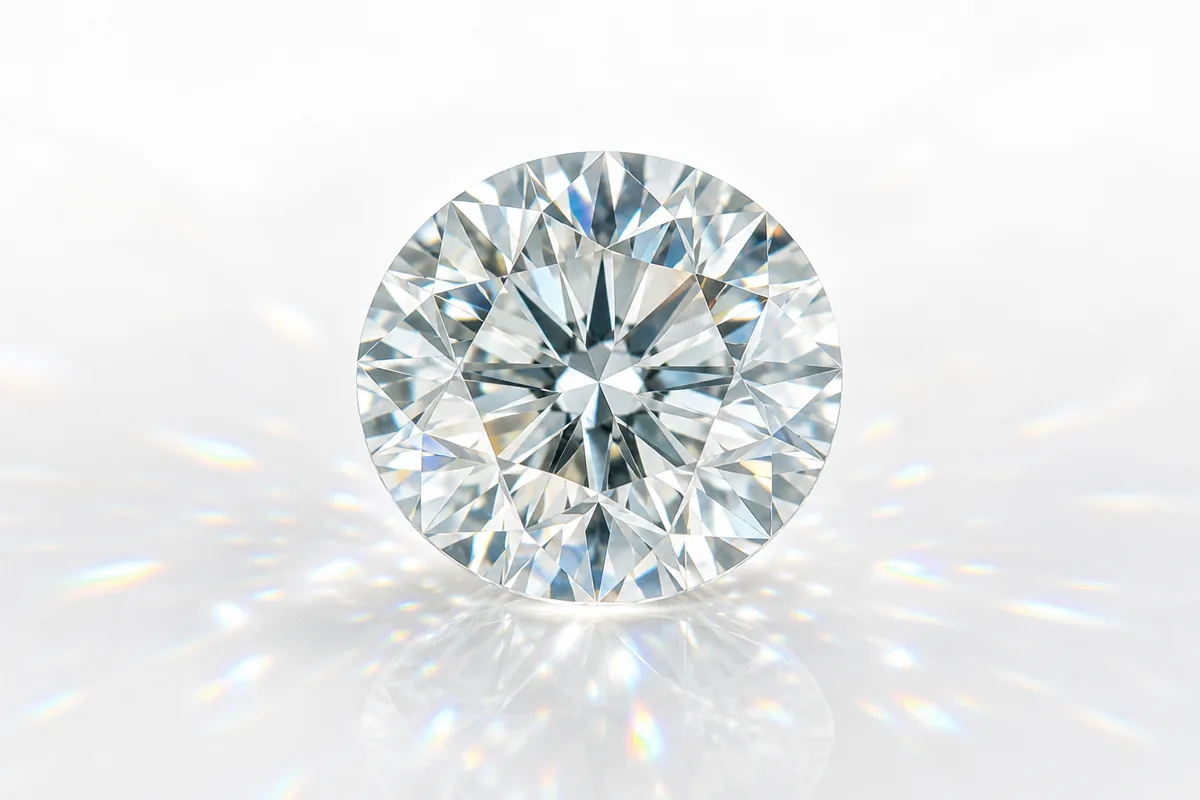
How to use a diamond colour chart without being misled by it
Charts compress a complicated grading scale into bands you can scan in seconds, which is exactly their value and their danger. A diamond colour chart can rank grades in order and show roughly where the eye starts noticing differences. It cannot tell you how this specific stone behaves, because shape, size, proportions, and the metal around the stone all change what you actually see.
Reading charts like a professional rather than a shopper
Professionals use charts to shortlist, never to decide. Two examples show why. Colour: the same H grade reads warmer in a one-carat emerald cut held in white gold than in a half-carat round brilliant in yellow gold, because step cuts hide less body colour and yellow metal masks warmth. Clarity: an SI1 can be completely eye-clean in a brilliant-cut round and obviously included in an emerald cut, whose open facets behave like a window. So read the chart, pick a band, then insist on seeing the stone or detailed video before treating the band as real. If a seller quotes only the chart position and resists showing the stone's behaviour in plain daylight, the chart is being used as a shield.
The shortcut that costs money
The expensive mistake is paying a premium for a paper band the eye cannot see, or accepting a discount band with a visible problem. Both happen when the chart replaces the stone. Grade boundaries are also not cliffs: a high G and a low F can be indistinguishable, while prices can step at the letter. The chart tells you where the steps are; the stone tells you whether the step is worth paying for.
When Prodiam is the right next step
Use the checklist to compare colour grade with the actual look. 4Cs.co.za is published by 4Cs.co.za: the education is free, the disclosure is permanent, and the specialist conversation is there when a real stone needs one. Bring the certificate or report number, photos in plain light, and any invoices or valuations, and the conversation starts from evidence instead of guesswork.
Decision table
Use the details, not a shortcut.
| Chart band | What it reliably tells you | What only the stone can tell you |
|---|---|---|
| Colour band | Relative warmth order on the D to Z scale | How the tint reads at this size, shape, and metal |
| Clarity band | Inclusion significance in grader terms | Whether this stone is eye-clean to you |
| Cut band | Proportion quality for round brilliants | The life of the stone in ordinary room light |
| Carat band | Weight, and roughly the price step points | Whether the stone carries its weight in spread |
| Any band | A shortlist range to inspect | The decision itself |
Direct answers
Common questions
Can I choose a diamond from a diamond colour chart alone?
Use it to set a range, not to choose. The same grade behaves differently across shapes, sizes, and settings, so the final call needs the stone, photos in plain light, or a trusted inspection.
Which grade band is the best value?
For many buyers the middle bands carry the value: near-colourless colour, clarity that is eye-clean rather than flawless, and the strongest cut quality the budget allows. Cut is the band least worth compromising.
Why do prices jump between similar grades?
The market prices letters and weight thresholds, not just appearance. Two nearly identical stones can sit on either side of a letter or a carat step, which is a chance for an informed buyer.
Do charts apply to fancy shapes?
Only loosely. Cut grading on most charts is built around round brilliants. Ovals, pears, emeralds, and other fancies need shape-specific judgement that charts do not capture.