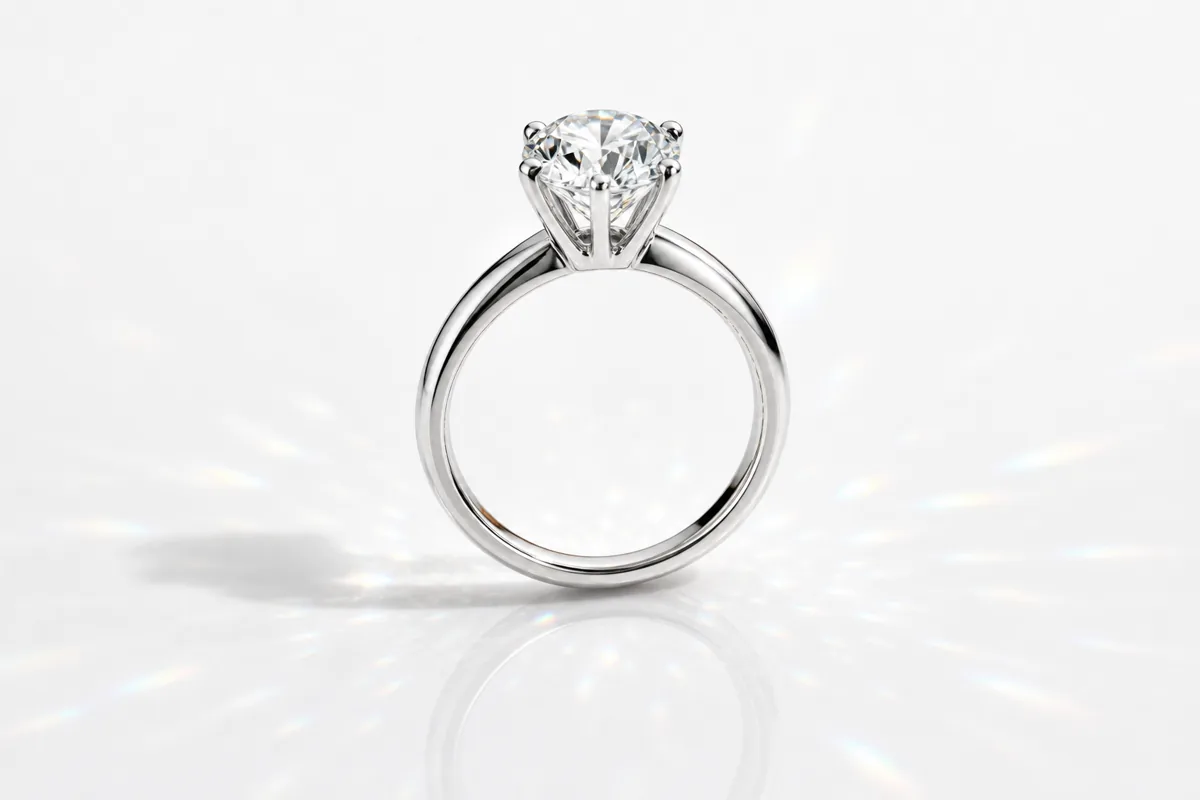
What size stud is right
Men's diamond studs typically run from 0.25ct to 1.00ct per stone. A 0.25ct stone per ear produces a clean, understated look. At 0.50ct and above, the stone becomes clearly visible at conversational distance. Carat weight alone does not tell you the spread: a well-cut stone measures larger face-up than a deep stone of the same weight.
Setting styles for studs
Bezel settings fully encase the girdle and are the most secure for daily wear and active lifestyles. Martini or three-prong settings give a lighter look and allow more light into the stone. Four-prong settings are common and hold the stone firmly. Push-back and screw-back fittings both work; screw-backs reduce loss risk but take longer to put on.
Stone grades that matter for studs
For a stud, eye-clean clarity matters more than a high certificate grade. Near-colourless (G-J) in white metal suits most buyers. Avoid very low cut grades: a poorly cut stone in a stud will look dark at the face even if the certificate grade is high. Fluorescence is less of an issue in stud settings than in large face-up stones.
Prodiam for diamond stud sourcing
Prodiam is a Johannesburg-based diamond dealer handling certified natural diamonds. For men's stud sourcing, the team can discuss stone specifications and certification. Contact Prodiam from the Bedfordview premises at Suite F1W6, The Paragon, 1 Kramer Road.
Decision table
Use the details, not a shortcut.
| Carat per stone | Face-up diameter (round) | Typical read at distance |
|---|---|---|
| 0.25ct | Approx 4.1mm | Subtle, understated |
| 0.50ct | Approx 5.2mm | Clearly visible, versatile |
| 0.75ct | Approx 5.9mm | Statement piece |
| 1.00ct | Approx 6.5mm | Prominent, high price jump |
| 1.50ct+ | Approx 7.4mm+ | Significant investment; certification essential |
Direct answers
Common questions
What size diamond stud is most popular for men?
0.25ct to 0.50ct per stone covers most purchases. Larger sizes exist but the price jumps are significant at 0.50ct and 1.00ct thresholds.
Do men's diamond studs need a certificate?
At 0.25ct and below per stone, certificates are uncommon. At 0.50ct and above, a GIA or recognised lab certificate protects the buyer on quality and resale.
What is the difference between a push-back and screw-back?
A push-back clips on and is faster to use. A screw-back threads on and is more secure, reducing the chance of losing the earring. Screw-backs are worth the minor inconvenience for higher-value studs.
Should I buy white gold or platinum for diamond studs?
White gold is more common and less expensive. Platinum is denser and more durable over time. Both show diamond colour well. White gold requires periodic rhodium re-plating to maintain its bright appearance.
Can I resell diamond studs later?
Certified natural diamond studs from reputable dealers resell better than uncertified stones. Bring the certificate and original documentation when approaching a buyer.
Does Prodiam sell individual stones for custom studs?
Yes. Contact Prodiam at a qualified specialist to discuss stone specifications for a pair of studs your jeweller will set.