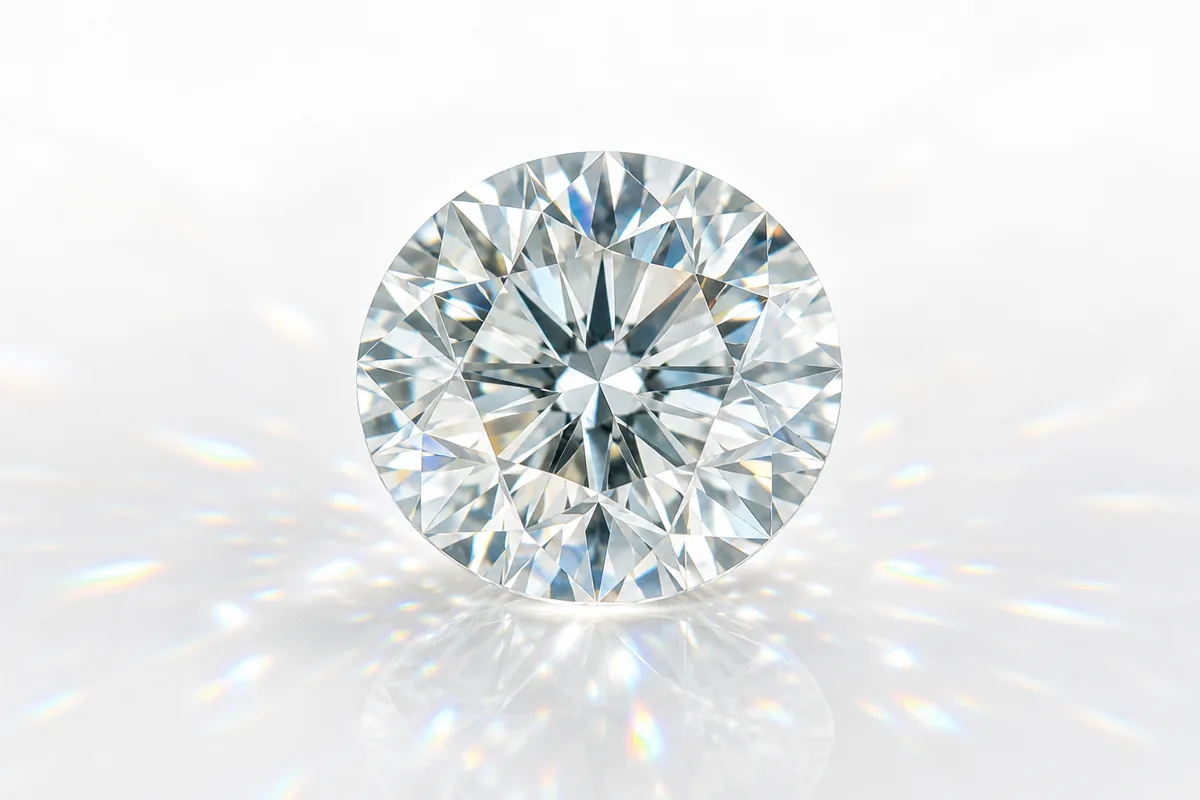
What makes a pear cut well-made
A well-cut pear diamond has a point that is sharp and clean without chipping risk, two shoulders that match in curve and height, a belly that is not too flat or too wide, and an overall symmetry that is visible when the stone is held upright. Asymmetry in a pear is immediately obvious to the naked eye and is difficult to correct without recutting the stone. Always assess the stone directly, not only from a certificate.
The bow-tie effect
Most pear cuts show some degree of a bow-tie shadow across the widest part of the stone. This is a dark band that appears across the centre in face-up viewing. A small bow-tie is acceptable and often unavoidable. A severe bow-tie kills brightness and indicates a proportion problem. You cannot identify the severity of a bow-tie from a certificate or a still photograph. Video in multiple lighting conditions is essential.
Length-to-width ratio and finger appearance
The length-to-width ratio determines how elongated the pear looks. A ratio between 1.45 and 1.75 is typical for most buyers. Below 1.45 the stone looks stubby and loses the visual benefit of the shape. Above 1.75 the stone becomes very narrow and fragile at the point. The right ratio is partly personal preference and partly practical consideration of how the stone sits in a setting.
Pear cut settings and protection
The point of a pear cut is the most vulnerable part of the stone and should be covered by a V-prong or a bezel enclosure. Open or claw prongs at the tip can chip or catch on fabric. The sides of the stone also need prong coverage without obscuring too much of the outline. Prodiam in Bedfordview can source and assess certified pear cut diamonds. Contact Prodiam.
Decision table
Use the details, not a shortcut.
| Attribute | Recommended | Avoid |
|---|---|---|
| Length-to-width ratio | 1.45 to 1.75 | Below 1.35 or above 1.85 |
| Bow-tie severity | Minor to none | Severe dark band across centre |
| Point condition | Sharp, clean, intact | Chipped, open, or rough tip |
| Shoulder symmetry | Both sides match | Mismatched curves or heights |
| Setting at point | V-prong or bezel | Open claws with no protection |
Direct answers
Common questions
Is a pear cut diamond the same as a teardrop cut?
Yes. Pear cut, pear shaped, and teardrop cut all refer to the same diamond shape with a rounded base and a single tapering point.
Does a pear cut diamond look bigger than its carat weight?
Generally yes. The elongated shape and larger face-up spread of pear cuts can make them appear larger than round brilliants of the same carat weight.
How do I check for the bow-tie effect?
View the stone face-up in daylight or equivalent lighting and move it slightly. A shadow across the widest part that does not shift much with movement indicates a bow-tie. Video from different angles is the most reliable check.
Which way should the point face on a ring?
Most wearers orient the point toward the fingernail, which creates the classic elongating effect. Some prefer the point toward the hand. Both are personal preference.
Can Prodiam source a pear cut diamond for me?
Yes. Prodiam handles certified natural diamonds in various shapes including pear. Contact a qualified specialist or call a qualified specialist to discuss what you are looking for.