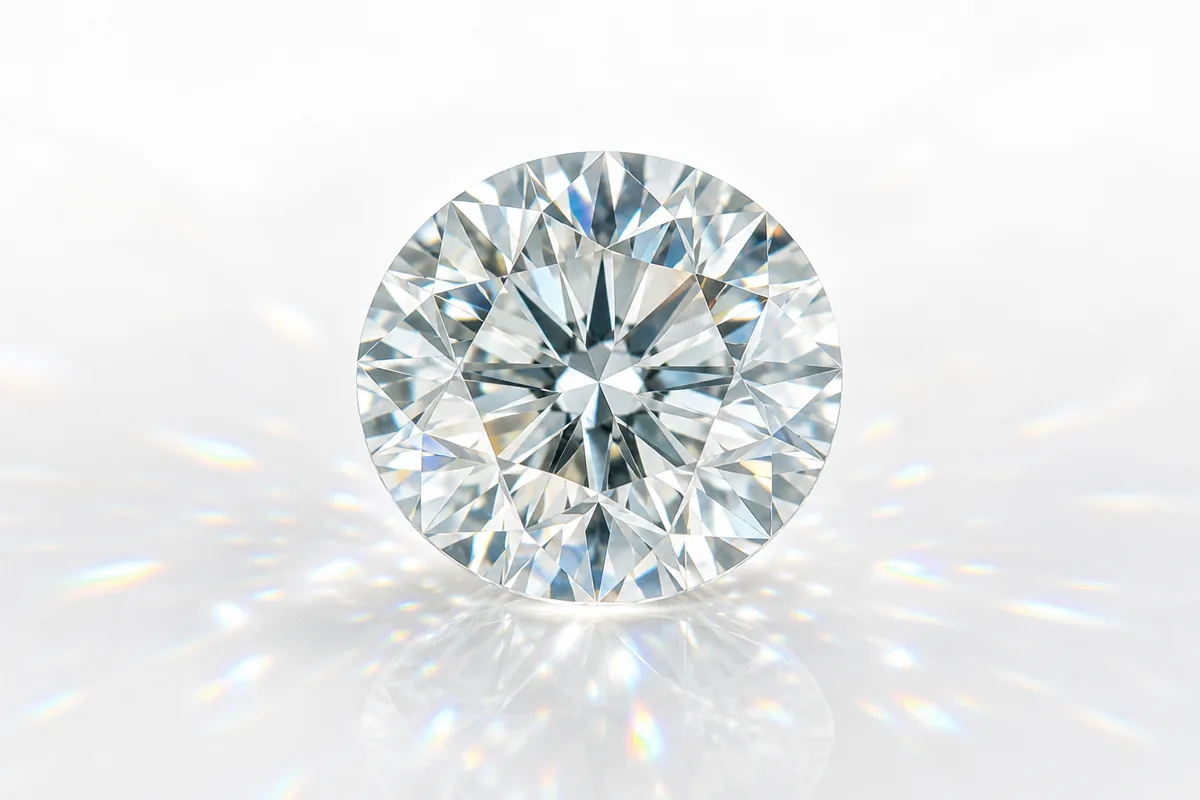
How the cut handles light
The princess cut has a modified brilliant facet arrangement on the pavilion that produces a different light pattern from a round brilliant. Rather than the uniform arrow-and-hearts pattern, it shows a distinctive X or chevron pattern. Light return is strong but varies more with cutting quality than in a round brilliant. A poorly cut princess can look dark in the centre.
Corner protection is essential
The four sharp corners are structural weak points. A chip at a corner can render the stone unrestorable in its current form. Setting styles that cover corners, such as four-prong settings positioned at each corner or bezel settings, reduce this risk. A claw positioned at the middle of a side rather than the corner leaves the points exposed.
What to read on a certificate
For princess cuts, the GIA report lists length-to-width ratio, table percentage, depth percentage, and Polish and Symmetry grades. A ratio close to 1.00 gives a square outline. Ratios above 1.05 trend rectangular. Table percentage in the mid-60s to low 70s tends to perform well. Depth percentage around 68-75% is typical.
South African buyers and sellers
Prodiam, in Bedfordview, Johannesburg, handles certified natural diamonds including fancy shapes. For an inspection or valuation of a princess cut diamond, contact Prodiam.
Decision table
Use the details, not a shortcut.
| Factor | Target range | Risk if outside range |
|---|---|---|
| Length-to-width ratio | 1.00-1.05 for square | Noticeably rectangular outline |
| Table percentage | 65-75% | Too shallow or too dark |
| Depth percentage | 68-75% | Stone hides weight or looks small |
| Polish | Very Good or Excellent | Reduced surface brightness |
| Symmetry | Very Good or Excellent | Uneven facet pattern |
| Corner setting | Prong at corner or bezel | Chip risk at exposed point |
Direct answers
Common questions
Is a princess cut the same as a square cut?
Princess cut is a specific modified brilliant design. Other square cuts include the Asscher and the cushion square. Each has a different facet structure and visual character.
Do princess cuts show colour more than round brilliants?
Yes. The corners of a princess cut can concentrate colour, making tint more visible than in a round brilliant of the same grade. Buyers sensitive to colour may want to go one grade higher than they would for a round.
Can a princess cut diamond be re-cut?
In most cases, re-cutting is not practical. The square outline requires a specific facet arrangement, and cutting away the corners to remove a chip typically means re-cutting to a round or smaller fancy shape.
What metal suits a princess cut ring?
White gold and platinum suit the geometric, sharp aesthetic. Yellow gold works well for warmer-toned stones. The corner protection offered by the setting style matters more than metal colour.
Is a princess cut a good investment?
Fancy shapes including princess cuts generally have thinner secondary markets than round brilliants. If resale is a priority, a certified round brilliant in a recognised grade tends to trade more easily.