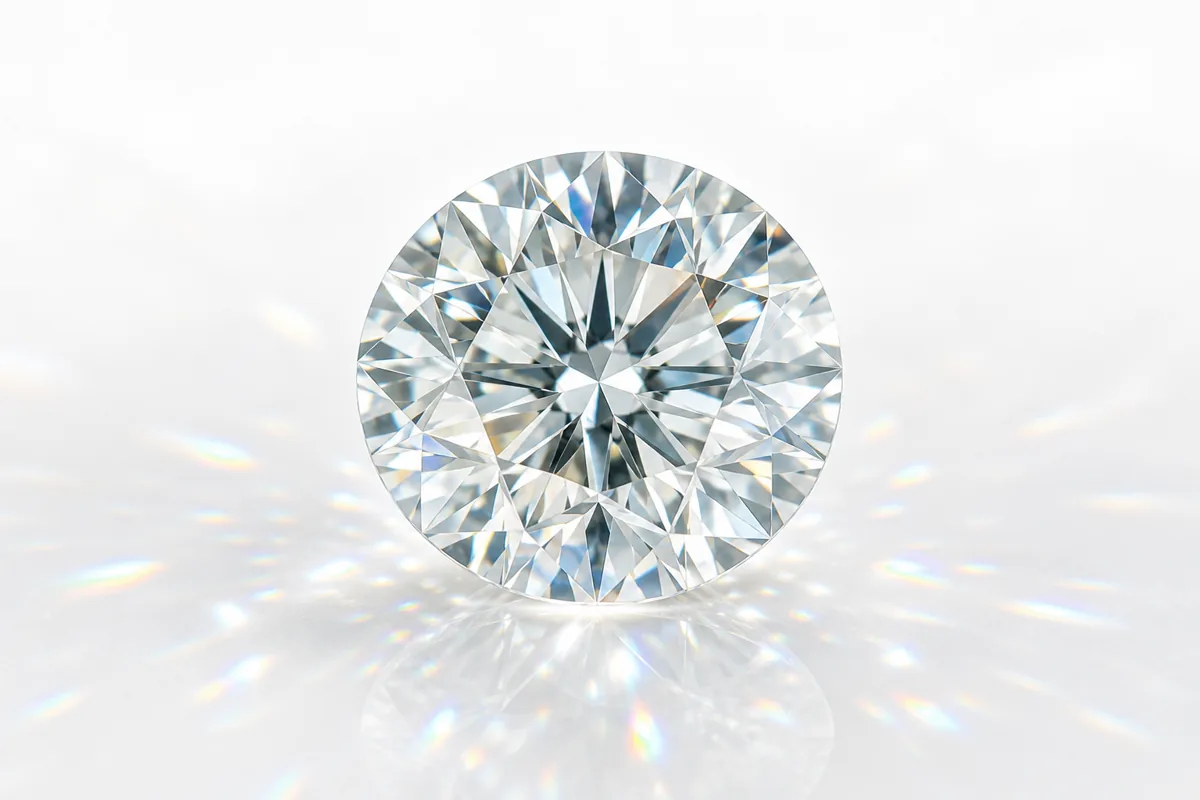
VVS1 and VVS2: the difference
Both grades describe inclusions that are difficult for a skilled grader to see under a 10x loupe. VVS1 is the cleaner of the two: what is there is usually only visible from the underside of the stone or is a pinpoint-sized mark. VVS2 allows slightly more, still invisible without magnification. The gap between them is a grader's distinction, not something you notice when the ring is on your hand.
Where VVS sits on the eleven-grade scale
GIA grades clarity in six groups: Flawless (FL), Internally Flawless (IF), VVS1 and VVS2, VS1 and VS2, SI1 and SI2, and I1 to I3. Each grade is set at 10x magnification by a trained grader who weighs five things for every inclusion: its size, how many there are, where it sits, what it is, and how much it stands out. VVS is the third-highest group and the highest that most jewellers ever stock.
What VVS adds to the price
Clarity is priced on rarity, not on looks. In Prodiam's sample of sourced natural diamonds captured on 6 November 2026 (H colour, 0.95 to 1.09 carat, VAT included), the median was about R69,600 at VVS1, R65,600 at VVS2, R61,000 at VS1, R56,300 at VS2 and R47,800 at SI1. At two carats the same steps ran from about R375,300 at VVS1 to R318,300 at VS2. In other words, moving from VS2 to VVS1 cost roughly a fifth more at one and two carats, for a difference you cannot see. These are dated guide figures, not quotes.
When VVS is worth it
Pay for VVS when you will look at the diamond closely or when the cut shows everything. Step cuts such as emerald and Asscher have long, open facets that act like a window, so inclusions a brilliant cut would hide can show. Very large stones magnify the same problem, because inclusions grow with the stone. VVS also makes sense if you want the certificate itself to be part of the value, for a gift that will be passed on or a stone you may sell to a trade buyer later.
When VS or SI is the smarter buy
For a round or oval brilliant up to about two carats, a well-chosen VS2 or a clean SI1 usually looks identical to a VVS stone once it is set. Put the saving into cut quality, which you can see across a room, or into a little more size. The catch is that the grade alone does not tell you whether an SI stone is eye-clean, so ask for a photograph or video of the actual diamond and check where the inclusions sit.
"VVS" in jewellery adverts
The letters only mean something when they appear on a laboratory report for that exact stone. Fashion jewellery, moissanite and some online listings use "VVS" as a marketing word, with no grading behind it. Before you pay a VVS price, ask for the report number and check it on the laboratory's own website, and make sure the inscription on the girdle matches it.
Decision table
Use the details, not a shortcut.
| Clarity grade | What a grader sees at 10x | What you see in a ring |
|---|---|---|
| FL / IF | Nothing inside (IF) or nothing at all (FL) | Nothing |
| VVS1 / VVS2 | Inclusions difficult for a skilled grader to find | Nothing |
| VS1 / VS2 | Minor inclusions, hard to easy to see | Nothing in most stones |
| SI1 / SI2 | Noticeable inclusions | Sometimes visible, check the stone |
| I1 to I3 | Obvious inclusions | Visible, may affect durability |
Direct answers
Common questions
What does VVS mean on a diamond?
Very, Very Slightly Included. It is a clarity grade from a laboratory such as GIA. VVS1 and VVS2 inclusions are difficult for a skilled grader to see even at 10x magnification.
Is VVS1 better than VVS2?
VVS1 is graded a step cleaner than VVS2. Neither shows anything to the naked eye, so the difference matters on paper and on price more than on the hand.
Are VVS diamonds worth the money?
For most brilliant-cut engagement rings, no: a VS2 or clean SI1 looks the same once set and costs noticeably less. VVS is worth considering for emerald and Asscher cuts, for very large stones, or if the grade itself matters to you.
How much more does a VVS diamond cost in South Africa?
In a dated sample of sourced natural diamonds from 6 November 2026, a 1 carat H colour stone cost roughly a fifth more at VVS1 than at VS2. The premium varies with weight, colour and the individual stone, so compare quotes for closely matched diamonds.
Can lab-grown diamonds or moissanite be VVS?
A lab-grown diamond can be graded for clarity by a laboratory, so it can carry a genuine VVS grade on its report. Moissanite is a different mineral; when it is sold as "VVS" the word is marketing unless a laboratory report says otherwise.
Is VVS the same as flawless?
No. Flawless (FL) and Internally Flawless (IF) are the two grades above VVS. A VVS stone has tiny inclusions; a flawless one shows none to a grader at 10x.